The British Museum has completed a major conservation project on its colossal Amitābha Buddha, returning one of its most iconic treasures to public display after more than two decades without full treatment.
Standing nearly six metres tall on a lotus base, the marble statue dates back over 1,400 years and represents Amitābha, the Buddha of Western Paradise. Conservation teams used scaffolding to clean and repair the surface, improve lighting and stabilise the plinth, allowing visitors to see the sculpture in renewed clarity at the museum’s North stairs.
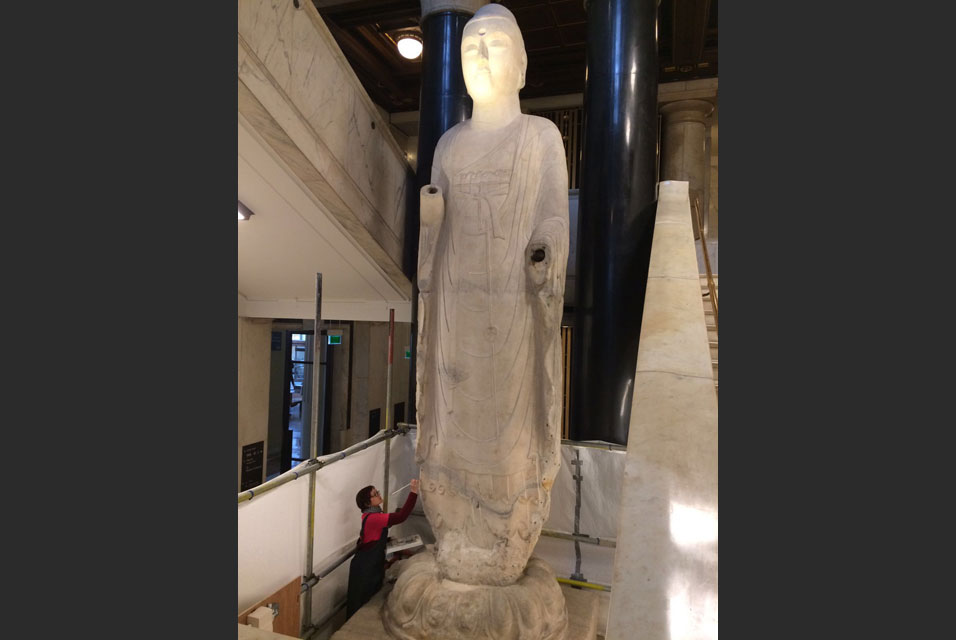
For the first time, experts were able to fully read an inscription on the plinth, revealing the Buddha’s original location at Chongguang Temple in Hebei Province, northern China. The text also names eighty members of the Yi-yi Buddhist society, patrons of the statue, who were active during the northern dynasties. Scientific analysis identified the wood in the left arm as jujube tree, cultivated in China for millennia for its fruit and medicinal properties.
The statue’s hands are now missing, but originally would have been carved in gestures of reassurance and generosity. Its solid form and sharply folded drapery are characteristic of the Sui period.
The Amitābha Buddha has a storied history in Britain. It was a centrepiece of the International Exhibition of Chinese Art at the Royal Academy in 1935–36, before being donated to the museum in 1938. Conservation was funded by the Bank of America Merrill Lynch Art Conservation Project, which previously supported the restoration of the Begram Ivories in 2011.
Jane Portal, Keeper of Asia at the British Museum, described the Buddha as “a powerful sculpture with a long history in China and a more recent story in the UK,” praising the project for enabling both conservation and new research. Andrea Sullivan of Bank of America Merrill Lynch said the initiative helps preserve cultural heritage “for the learning and enjoyment of future generations.”
Visitors can now view the restored Amitābha Buddha, a monument of faith and artistry, in its full grandeur once again.
About the Author