In southern Tajikistan, the ruins of Ajina‑Tepa preserve one of Central Asia’s most remarkable Buddhist monuments: a 12‑metre reclining Buddha dating back more than 1,300 years.
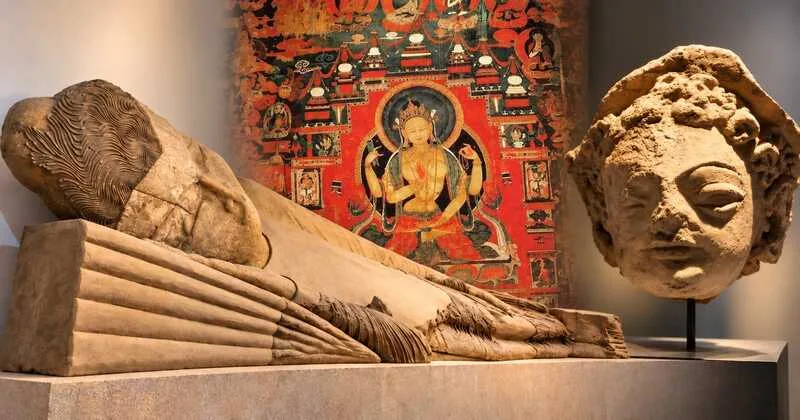
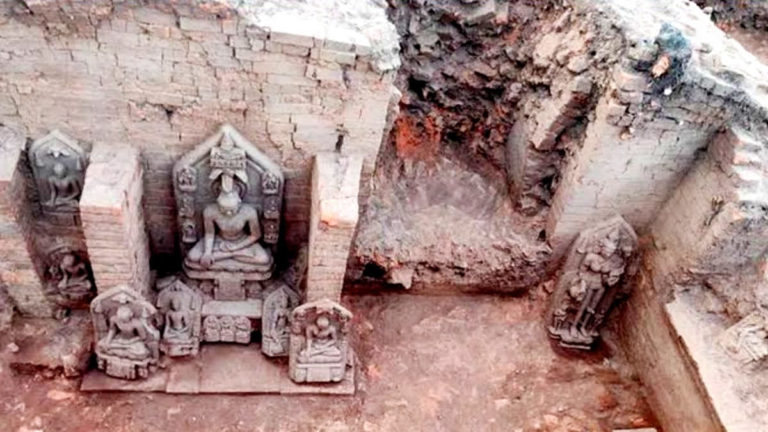
The site, near Bokhtar in the Vakhsh Valley, was once a thriving monastery built in the seventh and eighth centuries. Archaeologists have uncovered thick earthen walls, courtyards, stupas and painted fragments that reveal a substantial religious complex rather than a roadside shrine.
The colossal Buddha, now displayed in Dushanbe’s National Museum of Antiquities, depicts the moment of Parinirvana — the Buddha’s passing into Nirvana. Crafted from clay and originally painted, the figure reclines on his right side, his robe carefully modelled and traces of colour still visible. The feet alone measure nearly two metres.
Ajina‑Tepa’s sculptures belong to the Tokharistan Buddhist school, blending Gandharan and Gupta influences with local Central Asian artistry. They testify to the cultural exchanges that flourished along the Silk Road, where monks and pilgrims carried ideas of Dharma, compassion and meditation from Bharat into Central Asia.
The monastery’s decline came during the Muslim conquest of the region around 737–750 CE, when it was destroyed and abandoned. Centuries later, Soviet‑Tajik excavations between 1961 and 1975 brought the buried Buddha back into the historical record. Conservation efforts have since sought to protect the fragile ruins from erosion.
Today, Ajina‑Tepa stands as a poignant reminder that the Silk Road was more than a trade route. It was also a corridor for spiritual and artistic traditions, leaving behind monuments that echo the Dharmic heritage of Bharat across Central Asia.
About the Author