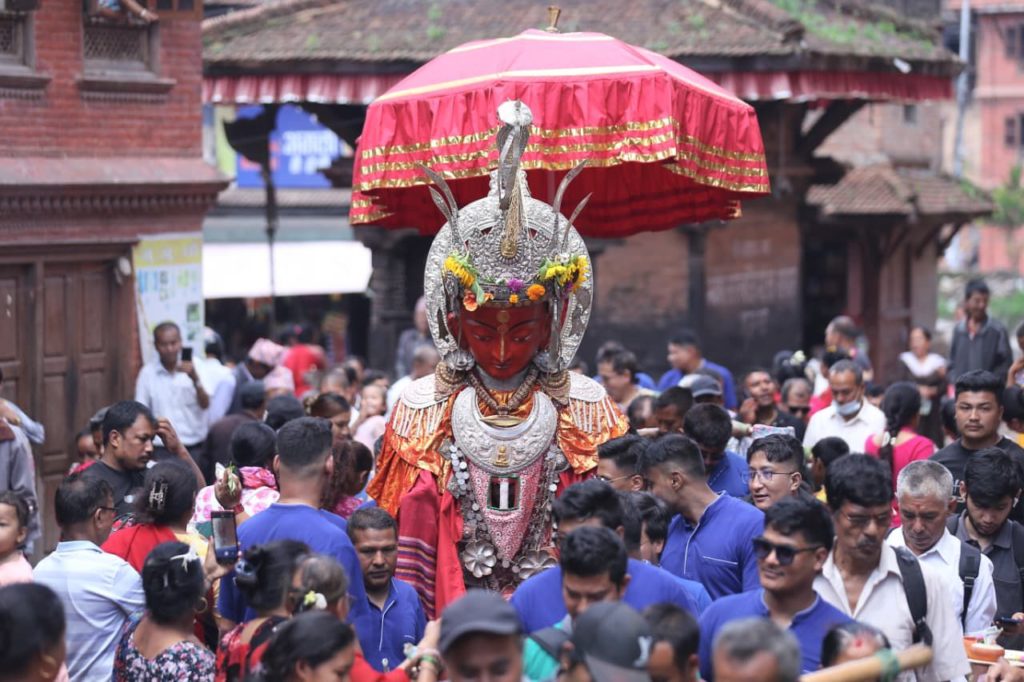
Bhaktapur’s ancient alleys came alive this week with the rhythmic pulse of drums and the towering presence of Dipankar Buddhas, as the city marked the annual Panchadan festival—a centuries-old Buddhist ritual rooted in the practice of almsgiving and spiritual merit.
Celebrated on Triodashi, two days before Kushe Aunsi (Father’s Day in the lunar calendar), Panchadan is more than a procession. It is a ceremonial tour of five Dipankar Buddha effigies through the city, accompanied by offerings, chants, and the display of Buddhist artifacts in homes and monasteries. The Dipankar Tathagat, along with Shakyamuni and Vajracharya figures, receive alms from devotees, continuing a tradition that dates back to Nepal Sambat 512 (AD 1390).
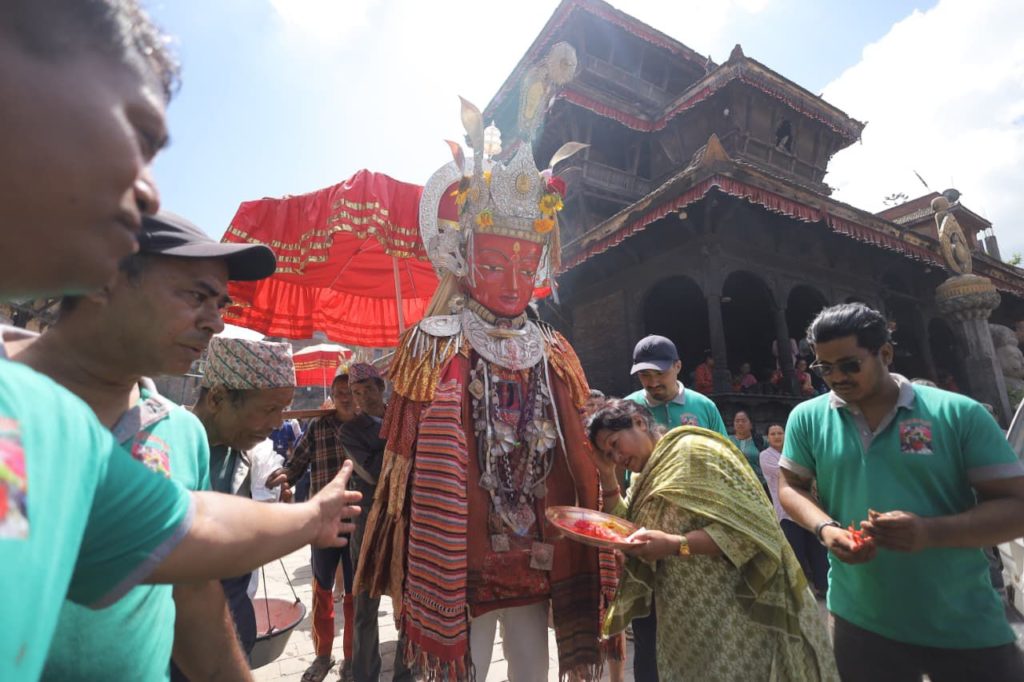
The festival’s core lies in the symbolic offering of five elements—wheat, rice, salt, money, and fruit—each representing a facet of life: sustenance, purity, prosperity, vitality, and fortune. These gifts, given according to one’s means, reflect the Buddhist principle of dana (charity) and reinforce communal bonds. As Surya Bahadur Chitrakar, a local devotee, noted, “It is counted as a good deed once you donate or give alms. The volume of donations is dependent on one’s capacity.”
Though monastic Buddhism has faded in Nepal, the ritual persists through the Shakyas and Vajracharyas, who now receive the offerings. Their presence, moving from house to house, evokes the ancient image of Bhikshus collecting alms—a practice believed to have originated in regions like Kinnaur, Tibet, Lahoul, and Spiti, where monks once relied on Cordyceps sinensis for sustenance.
Dipankar Buddha, revered as a precursor to enlightenment, embodies a transitional stage toward Buddhahood. His effigies, paraded through Bhaktapur, are not merely icons but reminders of the spiritual journey and the enduring legacy of Newar Buddhist culture.
In a time of rapid change, Panchadan remains a vibrant assertion of identity. It is not only a religious observance but a cultural affirmation—where heritage, generosity, and devotion converge. For Bhaktapur, the festival is a living archive, preserving the rhythms of the past while nourishing the spirit of the present.
About the Author