At the National Museum of Korea, a Gandhara Bodhisattva statue dating from the 2nd–3rd century stands as a striking example of how Asian art absorbed and transformed influences from far beyond its borders.
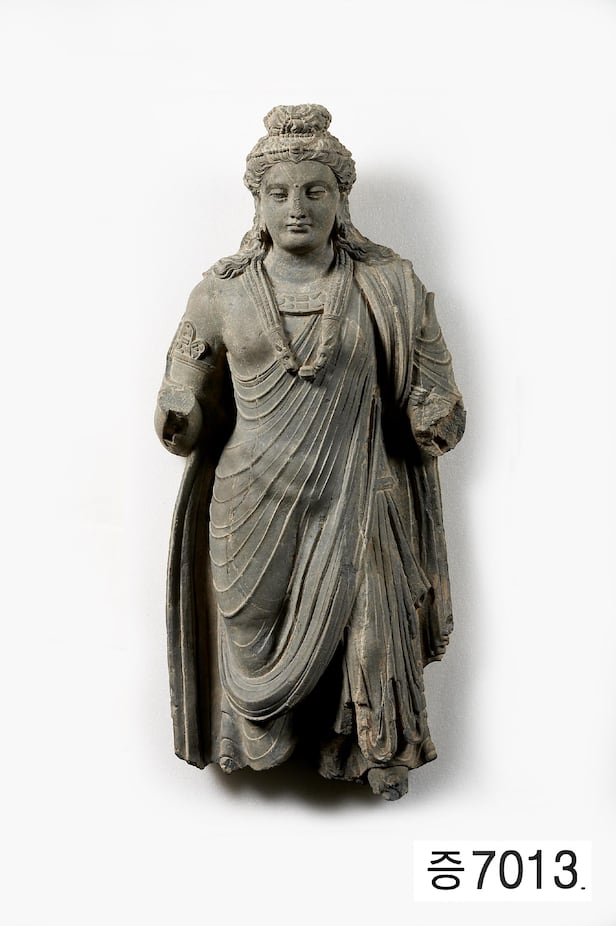
Originating in Gandhara — a region spanning present‑day northwestern Pakistan and northeastern Afghanistan — the sculpture reflects the moment when Buddhist imagery shifted from symbolic forms like footprints or trees to fully human figures. Gandhara artists pioneered this tradition, blending local and Indian styles with Greco‑Roman aesthetics introduced after Alexander the Great’s campaigns.
The Bodhisattva’s balanced facial features, idealised proportions, and realistic drapery echo classical Mediterranean art, while its spiritual presence and iconography remain firmly rooted in Buddhist tradition. Though highly three‑dimensional in appearance, the statue is closer to a relief, with its back left uncarved — a design suited to temple niches where multiple figures were displayed side by side.
Acquired by the museum at a Christie’s auction in 2008, the piece has become a centrepiece of its India and Southeast Asia Gallery. For scholars, it illustrates the cosmopolitan exchanges that shaped Gandhara’s cultural landscape. For visitors, it offers something simpler yet profound: a reminder that beauty can transcend cultural boundaries, uniting East and West in a single work of art.
About the Author