Preserving centuries-old Buddhist sculptures has long been a challenge for historians and conservationists. Fragile pieces, often hidden away in vaults or remote sites, risk being lost to time, conflict or environmental damage. Now, researchers believe digital reconstruction could offer a lifeline.
Traditional methods such as photogrammetry rely on multiple images, but rare artefacts often exist in only a single view. Replicating the human ability to infer three-dimensional form from one image has proven difficult for computer vision systems. While deep learning has made strides, existing approaches still struggle to capture the intricate textures and stylistic details that define Buddhist art.
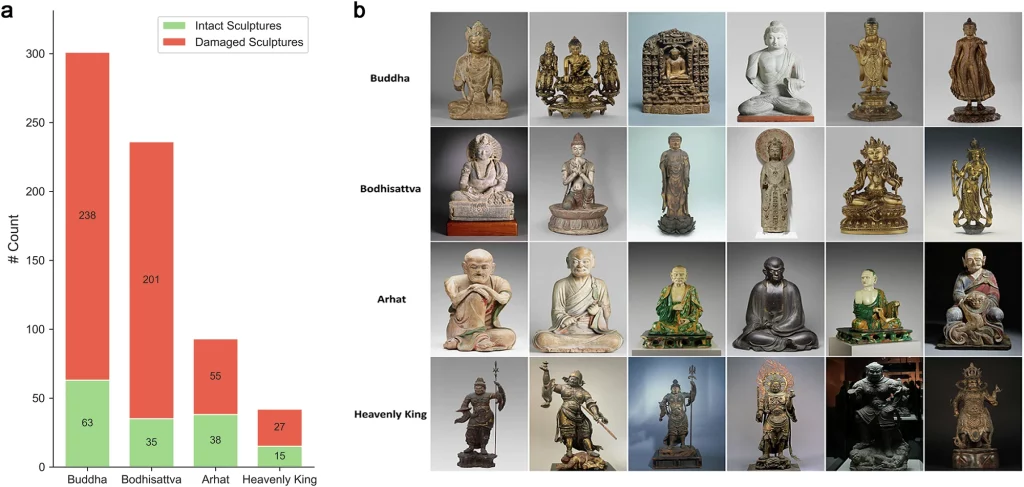
A new framework aims to change that. By adapting Stable Diffusion to generate consistent orthographic views and fine-tuning it with a curated dataset of 672 Buddhist sculptures, researchers have created a system capable of producing high-resolution multi-view images. These are then processed through a two-stage upscaling pipeline using ControlNet and Real-ESRGAN.
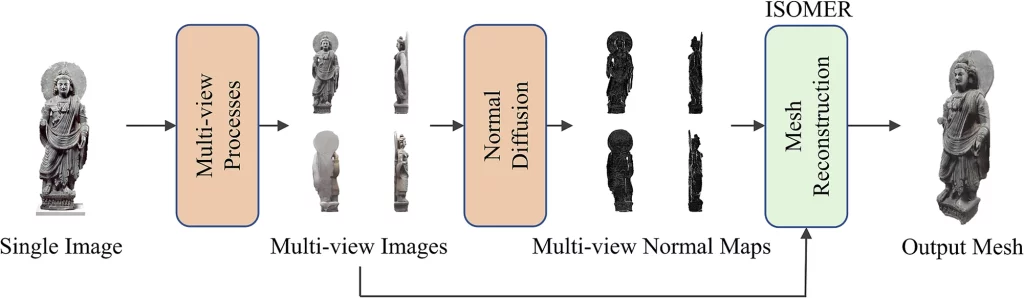
At the heart of the innovation is the Instant and Consistent Mesh Reconstruction (ISOMER) algorithm, which employs differentiable rendering and targeted optimisation to rapidly build accurate 3D meshes. Tests show a 7.1 percent reduction in Chamfer Distance and a 2.2 percent increase in F-Score compared with leading methods, while preserving delicate iconographic details.
The project’s contributions include:
- An end-to-end framework for single-image 3D reconstruction of Buddhist sculptures.
- A dedicated dataset and fine-tuning process to ensure cultural authenticity.
- Demonstrated improvements in accuracy and detail over state-of-the-art techniques.
Challenges remain, particularly with reflective or translucent materials, but future work will explore physics-based rendering and domain adaptation to broaden applicability. Beyond Buddhist art, the approach could extend to diverse cultural artefacts, offering a powerful tool for heritage preservation in the digital age.
About the Author